
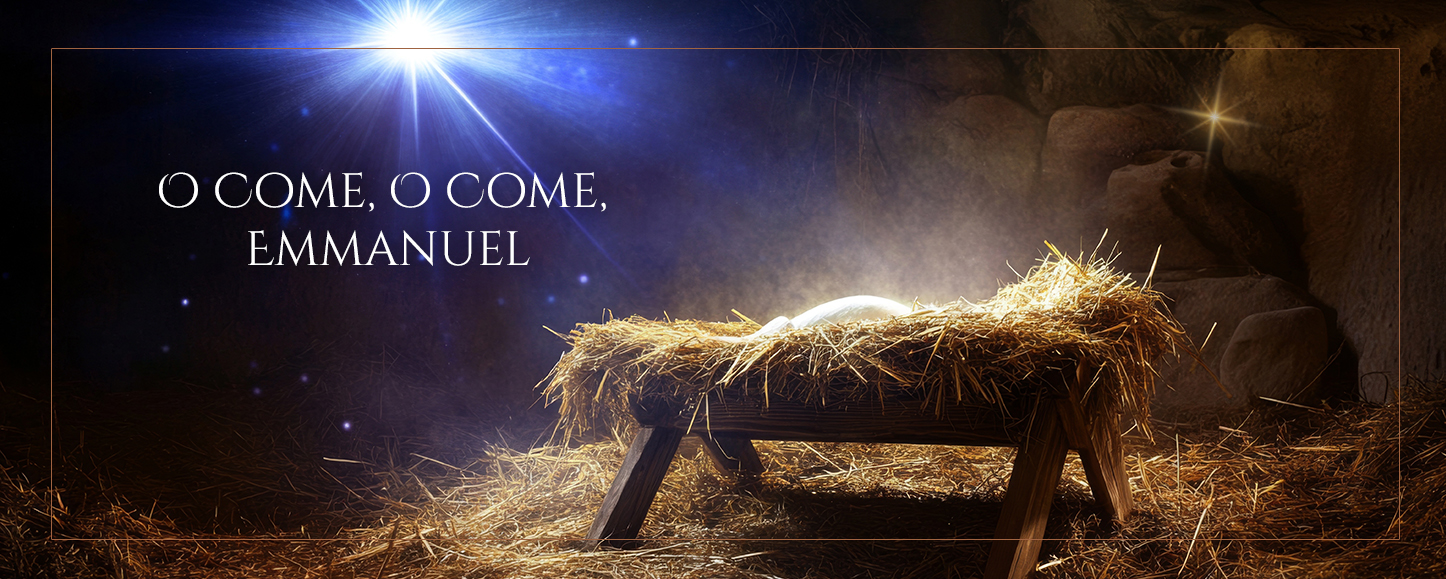
The hymn we are going to study today is O Come, O Come, Emmanuel, and I’m very excited to take a few moments to explore the meaning behind this beautiful song. This hymn is actually a very old Latin hymn, written originally in the ninth century. Its author is unknown, and over the years it has been translated and adapted many times. Even today, there are several versions with differing numbers of verses—some drawn from the original Latin and some added by more modern writers.
For our purposes, we’ll be using the version found in the Hymns of Grace hymnal, which contains four verses rendered by two different translators.
This hymn is theologically rich and full of references to Christ in both the Old and New Testaments. This is a hymn of hope, of expectation, of a longing for our King, the Lord Jesus, to appear.
Advent- or the time leading up to Christmas, is a wonderful time to dwell on the promises of God found in scripture- especially those relating to the promised Messiah. So let’s dive in- In the first verse we sing “O come, O come, Emmanuel.” Emmanuel means “God with us,” a name foretold by the prophet Isaiah in Isaiah 7:14: “Therefore, the Lord Himself will give you a sign: behold, a virgin will be with child and bear a son, and she will call His name Immanuel.”
Israel waited longingly for hundreds of years to see the fulfillment of this promise, and this first verse reflects the deep longing they must have felt as they awaited the first advent of the Messiah. They looked forward to the time when the promised Son of God would appear.
The second verse calls Christ the Dayspring. This name is drawn from Luke 1:78—“Because of the tender mercy of our God, with which the Sunrise from on high will visit us.”—and from Isaiah 9:2: “The people who walk in darkness will see a great light.” We have to remember that God had been silent for many years before the birth of Christ. The people truly were walking in darkness. But Christ came as the dawn of redeeming grace—the great light they longed for had finally appeared. This light would disperse the gloomy clouds of night and give flight to the dark shadows of death.
In the third verse we sing “O come, Thou Rod of Jesse,” which comes from Isaiah 11:1: “Then a shoot will spring from the stem of Jesse, and a branch from his roots will bear fruit.” After the Babylonian captivity, it may have seemed as though the Davidic line had been cut down. Yet Isaiah foretold that the Messiah would arise like a branch from the roots of Jesse. The people of Israel waited for this Rod of Jesse—the one who would free them from the tyranny of sin and of Satan, the one who would save His people from the depths of hell and give them victory over the grave.
All three of these verses point to Christ’s first advent: He came as the ransom for many, He brought light into darkness, and He gives victory over the grave to all who trust in Him for the forgiveness of sins. Christ is the fulfillment of all Messianic promises.
Now, in the fourth verse, we sing with expectation of His second advent. He is the Desire of Nations, and He will come again to bring peace to the whole earth. We, like the saints of old, long for this coming Messiah with hope and anticipation. As we sing “O come, O come,” it should stir in us that same longing—a deep hope shared across generations as we look for our promised Emmanuel, the Dayspring, the Desire of Nations, to come again and make all things right. We have faith that our covenant keeping God will bring this to pass just as He has promised. And we rejoice that Immanuel will indeed come again.
So this Christmas, as we sing this ancient hymn, let us remember the believers in the Old Testament who waited for His first advent, the believers in the New Testament who rejoiced at the birth of the Messiah long foretold, and let us now wait expectantly for the second advent of our glorious Lord—the risen Christ whom we love. May we be found faithful on that day, waiting joyfully for our King, walking in obedience to His word, and giving thanks in all things.
O Come, O Come, Lord Jesus. Come soon.
~ Sara B.